Thursday, 12 December 2019

:: RAVENNA ::


Teatro Alighieri - Ravenna


In less than a week, I will be playing here! I was asked again to raise funds for the Associazione Vittorio Tison. After last year's concert in beautiful Forli', this year I will be playing in this gorgeous theater in Ravenna: Teatro Dante Alighieri, dedicated to the famous poet who spent the last years of his life in the city. 


Building started in 1838 and was inaugurated only in 1852. The two Venician architects, Tommaso and Giambattista Meduna, had just finished restoration of the Fenice in Venice, after one of the many fires who, throughout its history, had attempted to the life of this prestigious theater. In fact, the two theaters are not too dissimlar:


Teatro La Fenice - Venice


Among the musicians that played here, there were Arturo Bendetti Michelangeli, Cortot, Milstein, Segovia, the Quartetto Italiano, ...

However, I will be playing in the smaller hall, called il Ridotto, dedicated to Arcangelo Corelli in 2004, in occasion of the 350th anniversary of the birth of the famous composer, who was born in 1653 in Fusignano - close-by, in the province of Ravenna.- 

Capital of the Western Roman Empire from 402 to 476, Ravenna is a UNESCO World Heritage Site. It was originally a port town, and as such, easily in contact with the Eastern Roman Empire. 


Monday, 18 March 2019

ARPEGGIONE Sonata - Franz Schubert (1797-1828)

Sonata in A minor for Arpeggione and Piano, D.821(1824)


Arpeggione
The arpeggione was a very short-lived instrument invented by the Austrian luthier Johann Georg Stauffer.  He had received, together with Johann Ertl, an imperial commission to improve the guitar. In 1823, Stauffer built his Arpeggione, a sort of hybrid between a guitar and a cello. The first models resembled more a guitar with similar shape of the body and of the sound holes, but a few years later the instrument morphed into something closer to the cello (like the one shown at the Metropolitan Museum in New York). The Arpeggione is a six-stringed instrument, fretted and tuned like a guitar (E-A-D-G-B-E), but bowed like a cello and without an endpin, thus held between the knees. A few original instruments have survived and one can be found at the Metropolitan Museum in New York.

Met Museum - Arpeggione
The sound was quite gentle and couldn't therefore compete with the other louder string instruments. The instrument was quickly forgotten and not much literature for it survived, other than Schubert's masterpiece.


The Sonata, written in 1824, is dedicated to Vincenz Schuster, a virtuoso of the instrument who commissioned the piece to Schubert. After Schubert's death, the Sonata was forgotten until 1871 when it was printed but in a transcription for cello, being by then the arpeggione already a forgotten instrument.  Today it is performed usually on either the viola or the cello.

The Sonata is in three movements, with the second, a beautiful short Adagio, flowing into the Allegretto with a small cadenza.


Monday, 11 March 2019

Michael Pepa'80th Birthday :: Certificate of Honour from the City of Cobourg


Our friend Michael Pepa just turned 80 years old!


Hard to believe by looking at the enthusiasm and at the continuous stream of ideas that keep pouring out of him.

On January 12th and 13th, 2019, the Canadian Sinfonietta, conducted by Maestro Tak Ng Lai performed two full concerts with mostly Pepa's music, one in Markham and the other in Cobourg, where he now resides.


Between the two concerts, almost a thousand people came to honour this important event. Of course, he had to give one of his very long speeches!


 Rachel Mercer, Lynn Kuo and myself played each one of his pieces for our instruments and orchestra, while Joyce Lai played the beautiful Mozart Adagio K.261.

Here Rachel is playing Pepa's MUTATIONS for Cello and Strings in Markham


Lynn is performing Pepa's Fantaisie Bohemienne for Violin, Piano and Strings


Joyce is performing Mozart Adagio K261

and I got to play his Yakami Variations, which he wrote for me a few years ago!

with the percussion part!


With Maestro Lai, Aster Lai, and with fabulous pianist Nada Kolundzija, who came all the way from Belgrade to celebrate this important milestone.


After the concert in Cobourg, Michael was presented with a certificate of Honour from the City of Cobourg!


and a letter from the Mayor of Cobourg

Here we are all together at the end of these two fabulous days:

Sunday, 8 October 2017

Tour September 2017: CANADA 150th Anniversary

Water Organ - Zadar - Croatia

Again - What a wonderful trip!

Incredible to think that it all went by really in less than 10 days: meeting with Joyce in Trieste to rehearse before the tour (and, we have to admit, also to explore the town together since it was her first time there, although I am sure not the last!), then flying to Belgrade and meeting there our wonderful friend and splendid pianist Nada as well as Michael, then driving to Zagreb with an unplanned lunch break in Bosnia, reuniting with our dear friends in Zagreb and finally discovering the stunning Dalmatian town of Zadar! All interspersed with music and lots of eating, of course.

It all started in Trieste, as many things do :)


Joyce and I interspersed our rehearsals with our quest for the best coffee in Trieste.
The story of the coffee in Trieste starts quite far back, after the defeat of the Ottoman Empire at the steps of Vienna in 1683! The retreating army left behind these wonderful beans, the Turkish kahve, which soon became very fashionable in the Habsburg Empire. The beans were brought to the Empire from Alessandria in Egypt through the port of Trieste, a Free port since 1719. With the construction of the railway in 1857, the expanded manufacturing of the beans were supported by several import firms, important roastings companies and many cafes. We decided (and that wasn't easy as Trieste is home of many incredible brands, among which Illy and Hausbrandt) that one of our favourite was the Excelsior coffee. This has an interesting story, starting back at the beginning of the 1900 with the Gianfre' brothers importing onions! After the Second World War, they decided to specialize in coffee and in 1954 they sold their first kilogram.

Off we go to catch the plane to Belgrade

In Belgrade we were met by beautiful pianist Nada who also hosted us at her place. Composer Michael Pepa reached us also there...we played his music at every concert!


Our next stop was in Zagreb, where we had a few rehearsals with the fabulous Cantus Ansambl directed by Maestro Tak Ng Lai. This is Pepa, ready to listen to his Yakami Variations being rehearsed!


Already two years ago, Michael received the medal of the Order of Danice Hrvatske, a beautiful recognition of his work in the arts, supporting and creating musical projects between Canada and Croatia. The medals are named after Marko Marulic, the famous Croatian writer of the 15th century whose statue we visited in this trip!


The concert was hosted by the Cantus Ansambl and the Canadian Embassy in celebration of Canada's 150th anniversary. After the concert, the Canadian Ambassador, Daniel Maksymiuk, joined us for a picture:


The next morning we drove to "the oldest continuously inhabited Croatian city": Zadar, a gorgeous town on the Adriatic coast, inhabited since the Stone Age, then a 9th-century BC Illyrian settlement, a Roman Municipium in 59BC, then Roman Colonia, Byzantine after the fall of the Western Roman Empire, Croatian around the 10th Century, conquered by Venice, then part of the Austrian Empire after the fall of Venice in 1797 and until 1918, Italian after 1920 and back to Croatia after the Second WW. A stunningly beautiful city, where we were met by a very warm and enthusiastic audience, a beautiful Summer temperature and stunning old and new architecture. The Sea Organ is found here, designed in 2005 by the architect Nikola Basic, these steps into the sea hide several tubes and a resonating chamber which produce sounds through the varying pressure of the sea waves. 

A perfect place to end our musical journey.


Monday, 18 May 2015

Congratulations to Michael Pepa!!! :: Order of Danice Hrvatske ::

MEGLIO TARDI CHE MAI...Better later than never....


I am a little late in congratulating my good friend and companion in so many adventures of the last few years, composer Michael Pepa, on his last very exciting recognition! 


Ambassador Veselko Grubišić of the Embassy of the Republic of Croatia in Ottawa on March 18, 2015


On March 18th of this year, composer Michael Pepa was awarded REDOM DANICE HARVATSKE S LIKOM MARKA MARULIĆA, the Order of Danica with the figure of Marulić.
He was invited to Ottawa to meet the Croatian Ambassador, Veselko Grubišić, who presented him with the medals for his ongoing support of the Croatian culture. A quick look at his many projects will show that this is a very long relationship, built over so many years, which created some very solid and lasting collaborations (some of which I have been lucky beneficiary in the last couple of years).
The title of this honour, which can be compared to the Order of Canada, is quite detailed. The reason is that there are several Orders of Croatian Danica, but the one S LIKOM MARKA MARULIĆA is awarded for special merits in culture, while others are for science, education, innovation, sports,...

Marko Marulić, whose Latin name was Marcus Marulus Spalatensis, was a Croatian writer, born in Split in 1450. Most of his writings were in Latin, some in Italian, and he obviously wrote substantial works in the Croatian language as well. There is some speculation that he might have studied in Padova and have traveled in Italy, but he spent most of his mature life in the humanistic cultural circle of his native Split, covering many important roles on the judicial and administrative level. As an interesting anecdote, it seems that the first known use of the word psychology is attributed to him! It is his role as a patriotic figure, in particular in his efforts against the Turks, that gave him such an important place in Croatian history, in particular with his many biblical and secular poems in Croatian, the most famous of which was his epic poem Judita.
The medal itself has a picture of Marko Marulić with a book in his hands and the background of the city of Split, with its cathedral's bell tower.

I was looking to see who else had won such a medal in the past, and I recognized one other name: Berislav Šipuš, composer and the Minister of Culture of Croatia, Michael's good friend in Zagreb, also received the award in 2009!


A little addendum, a few years later, now 2017, we went back on tour to Zagreb and we took a picture with Michael and the "original" Marko Marulić !


Zagreb 2017

Sunday, 26 October 2014

Palazzo Sacchetti - Roma


Grand'era gia' la colonna del Vaio (Pigli), Sacchetti, Giuochi, Fifanti e Barucci e Gally e quei ch'arrossan per lo staio

Paradise, Canto XVI

Written references to the noble Tuscan family of the Sacchetti can be traced back already to the 10-11th Century, possibly descending from the Gens Cornelia of the Roman Republic.  As attested by Dante’s quotation in his Divine Comedy, the family was already established in Florence in the 12th Century. During Florence’s internal battles between the Guelfs (the supporters of the Papacy) and the Ghibellines (the supporters of the Emperor), most members of the family sided with the Guelf party. While in Florence, the Sacchetti family participated in the Battle of Montaperti, against the Ghibellines of Siena. Even though the Sienese win caused the Sacchetti at first to be exiled, they later returned to Florence and the family continued to hold there the highest offices of the Republic. At this point the family divided into two branches: one that remained in Florence until the Sixteenth Century, when they relocated to Rome when the Republic collapsed and the Principate of the Medici was established, and the Neapolitan branch, that went into the service of the Normans.

The current Roman family descends from Matteo Sacchetti and his wife Cassandra Ricasoli-Rucellai. Since then, within the family tree we find connections with some of the most prominent names such as Colonna-Barberini, Montefeltro della Rovere,… and titles, such as Marquis, Princes, Commissary General of the Papal troops, and the Cardinal Giulio Cesare Sacchetti (1586-1663), twice unsuccessfully nominated for election as Pope! ...until Giulio Sacchetti, the last Chief Quartermaster of the Vatican, who married Giovannella Emo Capodilista, who was the kind Marchesa who hosted my concert at Palazzo Sacchetti.


Marchesa Sacchetti
The Sacchetti were among the most important patrons of the Baroque Era, promoting and commissioning masterpieces by Pietro da Cortona, Andrea Sacchi, Nicolas Poussin, Simon Vouet, Guercino and Guido Reni. Their collection was sold in the Eigthteenth Century to the Pope Benedict XIV, becoming one of the foundations of the Capitoline Museum in Rome.


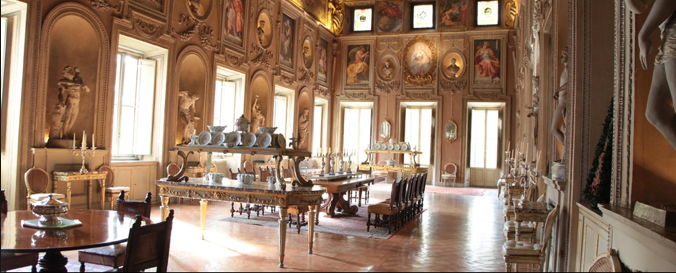
This is the Sala where I performed!

...and among frescos by Pietro da Cortona and le Storie di David of Salviati there was me! The whole night really felt like being in a movie and, as I discovered afterwards, Paolo Sorrentino indeed filmed La Grande Bellezza exatrly in here, in the very room where I performed! I found a beautiful article with many pictures that five an idea of the Palazzo and its many beauties here:
http://www.adayinrome.com/2014/05/15/con-italian-ways-a-palazzo-sacchetti/


This is where part of the reception took place...


Tuesday, 24 June 2014

Concerto a Palazzo Sacchetti - Roma


In a few days, on July 3rd, I will be performing in one of the jewels of Italian Renaissance: the Villa Sacchetti, very kindly opened to the audience by the Marchesa Giovanna Sacchetti.

The villa was designed and built in the very heart of Rome, in via Giulia, by Antonio da Sangallo for himself and his family to live in, and only in 1649 it became the residence of the Marquis Sacchetti. Antonio da Sangallo left Florence very young and had come to Rome to study with Bramante, whose style he followed during his many years working, aboung others, extensively for the Popes. Among other projects, he worked on the cortile of the Farnese Palace, later completed by Michelangelo and, of course, he was the chief architect for the Basilica di San Pietro in 1520.

Marcello Sacchetti - Pietro da Cortona (1627)


I am particularly excited to be performing in a hall frescoed by Pietro da Cortona, who also painted the vault in the main hall in Palazzo Barberini in Rome as well as the Sala della Stufa in Palazzo Pitti for the Medici family in Florence. Interestingly, his young talent was discovered while still in Toscany by Marcello Sacchetti, the papal tresurer during the Barberini papacy, who helped him make a name for himself in Rome. This contact brought him to work closely with Bernini, as well as gave him commissions by the pope Urban VIII (Maffeo Barberini) and the Cardinal Francesco Barberini.