Monday, 18 May 2015

Congratulations to Michael Pepa!!! :: Order of Danice Hrvatske ::

MEGLIO TARDI CHE MAI...Better later than never....


I am a little late in congratulating my good friend and companion in so many adventures of the last few years, composer Michael Pepa, on his last very exciting recognition! 


Ambassador Veselko Grubišić of the Embassy of the Republic of Croatia in Ottawa on March 18, 2015


On March 18th of this year, composer Michael Pepa was awarded REDOM DANICE HARVATSKE S LIKOM MARKA MARULIĆA, the Order of Danica with the figure of Marulić.
He was invited to Ottawa to meet the Croatian Ambassador, Veselko Grubišić, who presented him with the medals for his ongoing support of the Croatian culture. A quick look at his many projects will show that this is a very long relationship, built over so many years, which created some very solid and lasting collaborations (some of which I have been lucky beneficiary in the last couple of years).
The title of this honour, which can be compared to the Order of Canada, is quite detailed. The reason is that there are several Orders of Croatian Danica, but the one S LIKOM MARKA MARULIĆA is awarded for special merits in culture, while others are for science, education, innovation, sports,...

Marko Marulić, whose Latin name was Marcus Marulus Spalatensis, was a Croatian writer, born in Split in 1450. Most of his writings were in Latin, some in Italian, and he obviously wrote substantial works in the Croatian language as well. There is some speculation that he might have studied in Padova and have traveled in Italy, but he spent most of his mature life in the humanistic cultural circle of his native Split, covering many important roles on the judicial and administrative level. As an interesting anecdote, it seems that the first known use of the word psychology is attributed to him! It is his role as a patriotic figure, in particular in his efforts against the Turks, that gave him such an important place in Croatian history, in particular with his many biblical and secular poems in Croatian, the most famous of which was his epic poem Judita.
The medal itself has a picture of Marko Marulić with a book in his hands and the background of the city of Split, with its cathedral's bell tower.

I was looking to see who else had won such a medal in the past, and I recognized one other name: Berislav Šipuš, composer and the Minister of Culture of Croatia, Michael's good friend in Zagreb, also received the award in 2009!


A little addendum, a few years later, now 2017, we went back on tour to Zagreb and we took a picture with Michael and the "original" Marko Marulić !


Zagreb 2017

Sunday, 26 October 2014

Palazzo Sacchetti - Roma


Grand'era gia' la colonna del Vaio (Pigli), Sacchetti, Giuochi, Fifanti e Barucci e Gally e quei ch'arrossan per lo staio

Paradise, Canto XVI

Written references to the noble Tuscan family of the Sacchetti can be traced back already to the 10-11th Century, possibly descending from the Gens Cornelia of the Roman Republic.  As attested by Dante’s quotation in his Divine Comedy, the family was already established in Florence in the 12th Century. During Florence’s internal battles between the Guelfs (the supporters of the Papacy) and the Ghibellines (the supporters of the Emperor), most members of the family sided with the Guelf party. While in Florence, the Sacchetti family participated in the Battle of Montaperti, against the Ghibellines of Siena. Even though the Sienese win caused the Sacchetti at first to be exiled, they later returned to Florence and the family continued to hold there the highest offices of the Republic. At this point the family divided into two branches: one that remained in Florence until the Sixteenth Century, when they relocated to Rome when the Republic collapsed and the Principate of the Medici was established, and the Neapolitan branch, that went into the service of the Normans.

The current Roman family descends from Matteo Sacchetti and his wife Cassandra Ricasoli-Rucellai. Since then, within the family tree we find connections with some of the most prominent names such as Colonna-Barberini, Montefeltro della Rovere,… and titles, such as Marquis, Princes, Commissary General of the Papal troops, and the Cardinal Giulio Cesare Sacchetti (1586-1663), twice unsuccessfully nominated for election as Pope! ...until Giulio Sacchetti, the last Chief Quartermaster of the Vatican, who married Giovannella Emo Capodilista, who was the kind Marchesa who hosted my concert at Palazzo Sacchetti.


Marchesa Sacchetti
The Sacchetti were among the most important patrons of the Baroque Era, promoting and commissioning masterpieces by Pietro da Cortona, Andrea Sacchi, Nicolas Poussin, Simon Vouet, Guercino and Guido Reni. Their collection was sold in the Eigthteenth Century to the Pope Benedict XIV, becoming one of the foundations of the Capitoline Museum in Rome.


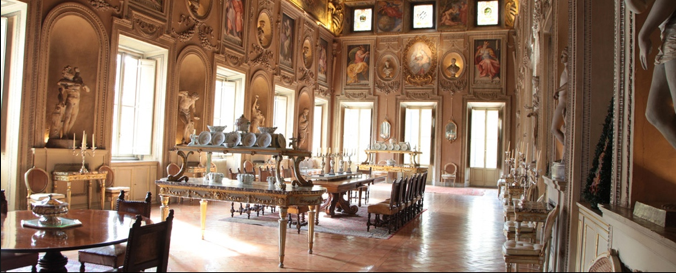
This is the Sala where I performed!

...and among frescos by Pietro da Cortona and le Storie di David of Salviati there was me! The whole night really felt like being in a movie and, as I discovered afterwards, Paolo Sorrentino indeed filmed La Grande Bellezza exatrly in here, in the very room where I performed! I found a beautiful article with many pictures that five an idea of the Palazzo and its many beauties here:
http://www.adayinrome.com/2014/05/15/con-italian-ways-a-palazzo-sacchetti/


This is where part of the reception took place...


Tuesday, 24 June 2014

Concerto a Palazzo Sacchetti - Roma


In a few days, on July 3rd, I will be performing in one of the jewels of Italian Renaissance: the Villa Sacchetti, very kindly opened to the audience by the Marchesa Giovanna Sacchetti.

The villa was designed and built in the very heart of Rome, in via Giulia, by Antonio da Sangallo for himself and his family to live in, and only in 1649 it became the residence of the Marquis Sacchetti. Antonio da Sangallo left Florence very young and had come to Rome to study with Bramante, whose style he followed during his many years working, aboung others, extensively for the Popes. Among other projects, he worked on the cortile of the Farnese Palace, later completed by Michelangelo and, of course, he was the chief architect for the Basilica di San Pietro in 1520.

Marcello Sacchetti - Pietro da Cortona (1627)


I am particularly excited to be performing in a hall frescoed by Pietro da Cortona, who also painted the vault in the main hall in Palazzo Barberini in Rome as well as the Sala della Stufa in Palazzo Pitti for the Medici family in Florence. Interestingly, his young talent was discovered while still in Toscany by Marcello Sacchetti, the papal tresurer during the Barberini papacy, who helped him make a name for himself in Rome. This contact brought him to work closely with Bernini, as well as gave him commissions by the pope Urban VIII (Maffeo Barberini) and the Cardinal Francesco Barberini.


Thursday, 1 May 2014

JAPAN!!!

New Musical Friends

About a month ago, I had the great privilege of playing two concerts with people I had just met – one of the many Beauties of Music - and thus making new very interesting friends: two beautiful musicians from Japan came to Canada for just over a week and offered me the occasion to learn a little bit more about their culture…just enough to have a glimpse into how much I really do not know, and even that, it was just a glimpse.

After our concert in Toronto


Takayo and Yasutaka (www.x-iksa.com) come from Matsue, a town on a river that connects two close lakes, hence acquiring sometimes the nickname of the Water City - a Japanese Venice? 


Of course I had to check on a map: first of all I discovered that Matsue is very close to one of the oldest Shinto Shrines of Japan, Izumo Taisha, just on the other side of one of the lakes.


That’s when I first discovered that, really, I knew NOTHING of Shinto.  This ancient native Japanese religion recognizes the presence of the divine spirits in nature: mountains, forests, and even rain,…can contain a kami, which is a worldly manifestation of the spiritual powers.  These spirits, which give life to humans, will return to nature after the death of a person in a renewable cycle. The physical “residence” of kami, a shintai, is a physical object such as Mount Fuji, waterfalls, mirrors, swords, jewels, such as, for instance, a Magatama! Thus I discovered that the wonderful pendant I often wear and that was brought to me from a recent trip to Japan, is actually a comma-shaped bead whose history can be traced back to Japan’s culture already in 1000BC! In ancient times it was made of stones, of course, and only successively mostly in jade.


It is such an important symbol that it is found also as part of a bridge in Matsue!


Interestingly, it was the beginning of agriculture which determined the need to attract the life spirits – kami -to ensure good harvests, and so the first shrines appeared. Around the 6th Century, though, Buddhism made its way to Japan, introducing the idea of a shrine that would now be permanent. For a long time the Buddhist temples and the Shinto shrines coexisted, with the temple built next to an existing shrine. From an architectural point of view, an interesting fact is that Shinto shrines were traditionally rebuilt at regular intervals, strictly following each time the original plan and design, and so are preserved till today almost intact, to protect the shintai and the kami which inhabits it.

  
Back to Matsue, one of its most famous ruler, Matsudaira Fumai, was a great enthusiast of the Tea Ceremony – a ritual that I have been finding incredibly intriguing lately - and a renowned tea master himself, and thus in 1779 built a famous tea house, which is still there: Meimei-An. There are special sweets – Wagashi -which are consumed during the Tea Ceremony, and Matsue is famous for several kinds, but the Wakakusa is the most famous one, the Spring one!  I will have to visit my new friends in the Spring.


A big discovery for me during this concert was the music of Toru Takemitsu, which I had of course studied in school, but never really worked on closely. I played his Rain Tree Sketches II, written in memoriam Olivier Messiaen. Not much is written in English, but I discovered that the whole concept of the Rain Tree comes from several stories by Nobel laureate Kenzaburo Oe, where the infinite tiny leaves of this life tree collect the rain and disperse it during droughts. It is beautiful and magical music, which, from a purely pianistic point of view, feels incredibly like playing Ravel, in particular my beloved Jeux d’eau.

A little Japanese side story - not surprising, knowing me -: on my way to my European Tour this past Fall, I met on the plane a wonderful Japanese Shiatsu Practicioner who lives in Toronto and with whom I became fast friends. Naturally, I invited him and his wife to our Japanese concert and it turns out he was coming with a great friend who is a violin maker here in Toronto, Mr. Masa Inokuchi. So, of course, after our concert we all were invited to see this incredible place where this wonderful family works untiringly on shaping, tapping, scraping, drying wood to make violins, violas, cellos and double basses! (www.inokuchiviolin.com)
With the not so good wood they make cutting boards: I got one as a gift and now proudly chop my veggies on a missed back of a violin.  


Please allow me one last Japanese thread: all this thinking of Japan brought me to have a special eye for anything Japanese in my daily life and so, looking at the wallet I carry every day, in a Proustian leap I suddenly went to two wonderful neighbors I had when I lived in Vancouver: Jun Wada and his wife Mary, who came to many of my concerts and gave the wallet to me on one occasion. As I discovered only after moving to Toronto, our quiet and friendly neighbor is in fact an incredibly famous neurologist, whose major research changed the world in the field of epilepsy. But then again, many of the people who lived on that street are very very special human beings.


This is from wonderful Mary

...and these are from my beautiful Friend Becky

また近いうちに

Sunday, 2 February 2014

Sala Tripcovich a Trieste – really the Sala Raffaello de Banfield


Under circumstances really along the lines of the best Pirandello stories – maybe partially also due to its Sicilian connections -, not only in terms of plot and characters, but especially of emotional sub-tones and unspoken implications, I was suddenly and unexpectedly “enlisted” to perform in my beautiful hometown, Trieste, to give a solo recital on December 27th at the Sala Tripcovich. 


I realized only afterwards that I knew very little of the history of the hall, not to speak of the shipping company that gave it its name or most of the people connected to it. So I did some research and found, as often is the case with such matters, many intertwined fascinating stories. One research lead to the next and I had to open many parentheses, much like in a long mathematical equation. I hope to keep it clear.

The concert hall where I just performed is known as Sala Tripcovich, carrying the name of the shipping agency, still operating today, that sponsored the renovation in the 1990s of what used to be a bus terminal. So, let’s go back several centuries.


The first known mention of the family Tripkovic - note the different original spelling -, stems from around the year 1000, when they were appointed with the title of counts by the Emperor of Byzantium. 


This is how the Byzantine Empire roughly looked then:


Already at this time, the Tripkovic worked in the field of navigation. They lived in the Bocche del Cataro, the Bay of Kotor, at the time part of the Byzantine Empire and today part of Montenegro.  In the following centuries, the family built a strong tradition of ship builders and was even involved in the rivalries between the Republic of Venice and that of Ragusa, as well as, later, in the battle of Lepanto, in 1571, when they sent three ships in support of the victorious Holy League against the Ottoman Empire. 


The family lived in the area for centuries and was found still in Dobrota in the mid 1800s. Then, the 22 years old Diodato Tripkovic left for Trieste, at the time the main harbor for the Austro-Hungarian Empire. In 1880 Diodato Tripkovic starts working for the Lloyd Austro-Hungarian; during these years he meets important traders on the ships and makes valuable connections for his own entrepreneurial future.  In 1895 he changes his name and founds the Tripcovich Shipping Agency: D.Tripcovich Societa’ di Armamento e Agenzia Marittima.  A note of colour: initially Diodato made a fortune shipping oak to France, where the oak was made into casks to age cognac! By 1910, his fleet of steamships carried passengers as well as goods all over the Mediterranean Sea, he owned a special fleet to pull and save boats in the harbor, and his became one of the most important fleets in WWI.  In 1921 his daughter, Countess Maria Tripcovich marries the Austro-Hungarian flying ace Goffredo de Banfield and here is where the two families come together.  Their son is Raffaello de Banfield.  Here opens another parenthesis, the square one I believe.


In very succinct terms and for the purpose of keeping the focus on the Sala Tripcovich, the colourful life of Raffaello de Banfield will be recalled with only a few salient facts: he studied composition with Malipiero in Venice and Nadia Boulanger in Paris, where he became lifelong friend of von Karajan, as well as met Picasso, Cocteau, and Poulenc. He then moved to the States where he became friends with Tennessee Williams, Leonard Bernstein and Maria Callas. In 1972 he came back to Trieste and became the Director of the Teatro Verdi.


In the 1990s, the Teatro Verdi was in need of serious renovation and Trieste found herself searching in a great hurry for a new place to host the musical events of the heart of the city, while still trying not to disrupt the programmed schedule of activities.  Raffaello de Banfield, also the head of the huge shipping empire Tripcovich, secured the financial support to turn an old bus terminal located just outside the main railway station of Trieste, and a few steps from the Teatro Verdi, into the new Sala Tripcovich. Incidentally, the Teatro Fenice in Venice had been completely destroyed by a fire a few years before and, during restorations, the musical events of the city took place in a tent, something that in Trieste, with the Bora, her famous wind at 170km/h, would simply be inconceivable. 


Let me open one last parenthesis here...we are at the curved one! The bus terminal was originally built in 1935 by the famous Triestino architect Umberto Nordio. Please excuse one final tiny parenthesis, his father was also a famous architect, the Trieste-born but Austro-Hungarian Enrico Nordio. He had studied architecture in Vienna where he collaborated to the restoration of the Stephansdom, as well as the nearby Kleusterneuburg, as well, also part of the Empire, as the Academy of Science and Arts and the cathedral in Zagreb! In 1888 Enrico Nordio had also participated in the competition for the new façade of the Dome of Milano.

Back to his son, Umberto Nordio, also born in the Austro-Hungarian Trieste. Among his main imprints in the city’s architecture, most notable are the new University (1938-50) and the Stazione Marittima.


Universita' di Trieste


Stazione marittima


Incidentally but for me most interestingly, he was a great supporter of the arts, both figurative and performing. His wife, Lidia Piani, had a diploma in Piano and for years the Trio di Trieste would rehearse at their home in via Cicerone!


So, back in 1992, thanks to the support of Raffaello de Banfield, director of the Teatro Verdi but also heir of the Tripcovich empire, the bus terminal built in 1935 by Umberto Nordio is turned in record time into the Sala Tripcovich!


In 1997, the Teatro Verdi is ready to be reopen and the two halls live parallel and symbiotic lives. There are many discussions today on what to do of the Sala Tripcovich which is by now named Sala Raffaello de Banfield after the latter's death in 2008. Still today, there have been bellicose supporters of the idea of demolishing the hall and so restoring the old open green space in front of the Railway Station, while others want to keep the building but to host youth events of various kinds, and the Teatro Verdi, of course, would like to keep it as part of its Fondazione for concerts and rehearsals.


In the meantime, here I was on December 27th!


Thursday, 7 November 2013

POLAND...at last!!!

Duo sTREga reunited:

Krakow and Zakopane!!!!


Wonderful Photo: Anna Dzięgiel


...and so, finally, I made it to Poland.  It has been on the wishing list for a while, but I guess I had to wait for the perfect time! And the perfect time it was: the Fall put on her best colours and I had some of the most welcoming experiences packed in four intense days of great music making. I am commenting on the "welcoming experiences" for a reason: it seems to me that while most cultures have some sense of pride in being good hosts, this is perceived at a very heightened level in Poland. I did say, half jokingly, that I felt like it was Christmas for four days and I was Santa Klaus on a rare visit, but in fact it wasn't so far from reality. I was literally inundated by gifts of flowers - at every concert and masterclass, even though everybody knew I was leaving after a few days-, all possible kinds of food - just in case I didn't feel like one thing, or maybe I wanted to try something different, and I had to try this special thing that is typical of here, which they have plenty of, be it on the street (the bruschetta-like zapiekanka), in a restaurant (szarlotka which, although delicious, I am assured is not quite the home-made apple pie of Maria - I'll need to check -, but still, YUMMY!!), on a mountain (oscypek: the squeaky cheese!), at home (with fancy porcini mushrooms!) -, and please, don't even thing of eating twice the same thing! -, infinite supply of chocolate that recreated itself in lovely boxes on my bed every time I was coming home, spectacular honey - which I already finished a while ago, so I now have to urgently go back to Poland! -, private performances just for me, to share the music, as well as private lessons to learn - and not succeed - how to say words in Polish,...just to name a few of these experiences. 


Photo: Anna Dzięgiel


In all this, one might thing that I wouldn't have the time to play a note, but NO!!
I arrived at Krakow airport where I was welcomed by tall smiley Kasia, made taller by a cheerful waving Canadian flag (thanks Becky!), and taken straight to a beautiful villa to play in a dance-filled concert organized by Gaia, Centrum Muzyki i Muzykoterapii, for some amazing kids, just look at this face:

Photo: Anna Dzięgiel

 Two days later we were driving to a Masterclass: two hours with fun talented students followed by a short sample of my upcoming performance.
 The same evening we had a photo shooting with amazing photographer Anna Dzięgiel - whose fun fun husband shared with us his tarantula's skin - the real tarantula was in a box eating a cricket! - which I managed to touch without passing out, but it was a close call: 

Photo: Anna Dzięgiel

Next morning we packed and drove to Zakopane, Szymanowski's home town and a beautiful little village South of Krakow, at the feet of the Tatra mountains and of the sleepy giant...and what a drive through the Fall-y hills!
Here is a proof that there, too, we didn't sit idly:


And the following day, my last day, we had another recital in Krakow:


Photos: Anna Dzięgiel


Thank you very much, dear Poland:

                 
                   do zobaczenia wkrótce!!!


Monday, 4 November 2013

Starting from the end of the Tour: the fabulous Zagreb Woodwind Trio


Montreal, La Chapelle Historique du Bon Pasteur (October 27th, 2013)
Toronto, Heliconian Hall (October 30th, 2013)


With the Zagrebački Puhački Trio, the Croatian Consul General and composer Michael Pepa

The end of the tour is a painful moment to face: coming home to the "normal" life after living for three weeks between incredible excitement, full and heightened concentration, and a generally high level of tiredness. Even doing your laundry in a normal laundry machine seems so uncool!

...but I am shamelessly lucky, and so some guardian angels decided to make it more bearable for me by taking a piece of tour back to Canada to smooth the first two weeks back...and I am not just talking about all the memories and experiences, but the Zagreb Woodwind Trio! which, by the way, in Croatian has for me an almost unrecognizable name: Zagrebački Puhački Trio. In passing, the other very interesting and unrecognizable name discovered on tour was skrzypce: which is the pretty violin in Polish...not to speak of my lovely country, which, also in Polish, is Włochy!

My whole Croatian experience has been distinguished by two main factors: one is meeting incredibly friendly, hospitable, and fun people with whom I felt immediate familiarity, and the other a distinguished encounter and performances for high government personalities. In Montreal with the Croatian Ambassador:


In Toronto, we performed for the General Consul of Croatia with whom we afterwards had a feast of cevapcici and calamari, and in Zagreb, well, among a sea of ambassadors and consuls, for the President of Croatia (!), and the Minister of culture Berislav Šipuš, who also happens to be a fabulous composer whose beautiful Preludes I was honoured to perform already twice!

With the Croatian President Ivo Josipovic and the Canadian Minister of State!!


With the trio, composers Berislav Šipuš and Michael Pepa, and violinist Lynn Kuo in Zagreb

 Incredibly, I had never visited Zagreb before, even though it is now, thanks to the new highway, only a few hours away from Trieste (a fact tested by my dad, who at the last minute decided to come to the performance and had some of the best times hanging out with ministers and consuls...and, most of all, with Michael and the Trio!). I found Zagreb incredibly beautiful, full of flowers, parks, fountains, colourful palaces and, what makes me feel right at home, the very strong stamp of the Austro-Hungarian empire in every building!


Performing Sid Rabinovitch in Zagreb!


 HVALA Zagrebački Puhački Trio!!!!!